High costs
Expensive and inefficient: new criticism of the climate ticket

The black-green government has invested billions in climate measures. Now the Fiscal Council has investigated how efficient the subsidies were. While the climate ticket is very expensive per tonne of CO2 saved, heating replacement and e-car subsidies are more effective and cheaper.
 Kronen Zeitung als bevorzugte Google-Quelle hinzufügen
 In order to achieve the ambitious climate targets, the public sector has to invest a lot of money. The billions spent by the government on climate subsidies have already had an effect, with emissions falling for the first time in years. But at what cost to the state and the economy as a whole? There are big differences here, with very expensive measures with little effect being offset by inexpensive measures with a greater effect.
Climate ticket is a particularly expensive measure
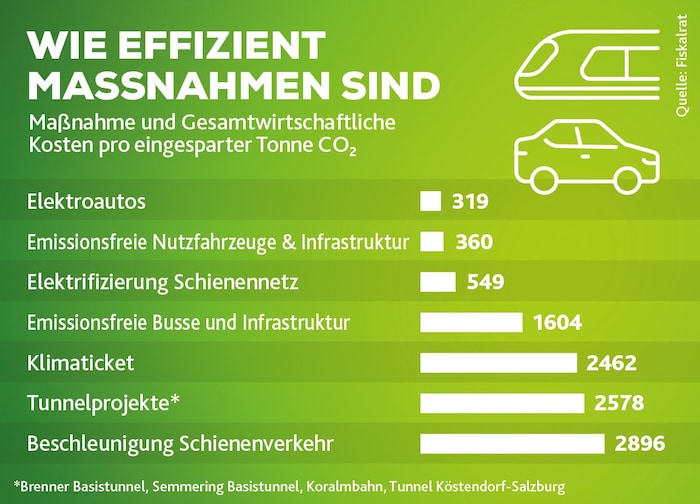
The prestigious green climate ticket project costs a particularly large amount of money with a rather low impact. To save one tonne of CO2, the state has to spend an average of 2462 euros. In total, the measure costs around half a billion euros.
Climate ticket "not just a climate measure"
Other rail investments are also very expensive for taxpayers when emissions savings are compared with the costs. However, the head of the Fiscal Council, Christoph Badelt, emphasizes that the climate ticket should not be seen purely as a climate measure, but is also a subsidy for commuting public transport drivers and public transport as a whole.
He also emphasizes: "We can't say now that we're doing this because it's efficient and not because it's inefficient. In the end, we will need a whole host of measures. We don't have the choice of either expanding transportation or replacing heating systems in order to achieve the corresponding CO2 savings."
"100 km/h costs little and achieves a lot"
Badelt therefore once again brings up the idea of a 100 km/h speed limit on freeways, which would save a lot of CO2 and at the same time cost the economy very little. "Apart from the cost of a few traffic signs, there would be few costs, but with an immediate effect," says Badelt. However, the measure is unpopular and politically difficult to implement.
However, there have also been more efficient measures in the transport sector in the past: the state can save more CO2 with less money by promoting e-cars; instead of 2500 euros, the ton of CO2 only costs the economy as a whole 319 euros. The cost-benefit calculation looks even better when it comes to replacing heating systems. Here, there is even a positive effect of up to 400 euros for the economy as a whole, as households benefit from the exchange.
Oecolution calls for promotion of climate adaptation
However, the business-oriented association Oecolution is calling for more focus to be placed on adapting to climate change. Funding for measures that serve both climate protection and adaptation, for example to extreme heat waves, would be ideal. This would include, for example, heat pumps that can also cool, or thermal refurbishment, as insulation not only reduces heating requirements in winter, but also protects against heat in summer. This would also reduce emissions. Companies will have to invest a lot of money in adaptation measures in the coming years. The problem of global warming is real and the economy now needs support to adapt to it, says Oeocolution Managing Director Elisabeth Zehetner.
This article has been automatically translated,
read the original article here.











Da dieser Artikel älter als 18 Monate ist, ist zum jetzigen Zeitpunkt kein Kommentieren mehr möglich.
Wir laden Sie ein, bei einer aktuelleren themenrelevanten Story mitzudiskutieren: Themenübersicht.
Bei Fragen können Sie sich gern an das Community-Team per Mail an forum@krone.at wenden.