Further away than ever before
Live: The Artemis II crew is now orbiting the Moon
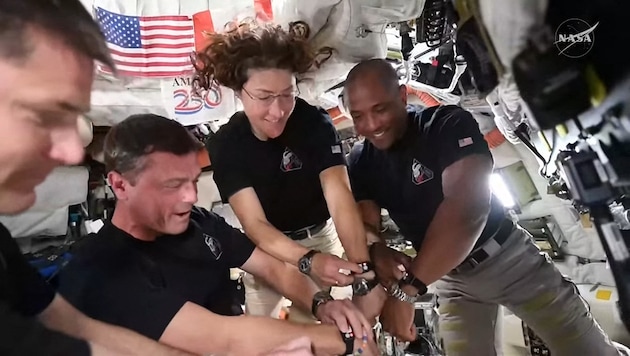

The four astronauts—Americans Reid Wiseman, Victor Glover, and Christina Koch, and Canadian Jeremy Hansen—will go down in history. As they orbited the Moon on Sunday in the Orion “Integrity” spacecraft, they set a record: At a distance of approximately 406,778 kilometers from Earth, they flew farther than any human before and surpassed the previous record set by “Apollo 13” (1970, 400,171 km). Now they are on their way back and will return home as heroes on Saturday at 2:07 a.m. (CEST).
 Kronen Zeitung als bevorzugte Google-Quelle hinzufügen
 It was truly a spectacular lunar night. At exactly 7:57 p.m. (CEST) on Monday, the moment had arrived: Through tears of joy, the crew realized they were already more than 400,171 kilometers from Earth, thereby breaking the record set by the “Apollo 13” mission in 1970.
“Today, you are crossing this boundary for all of humanity,” NASA engineer and astronaut Jenni Gibbons told the crew from the Houston Mission Control Center. The mission is a crucial test flight and paves the way for the first planned moon landing since “Apollo 17” in 1972. According to NASA, however, this is not scheduled to take place until 2028—no landing was planned for this mission.
Trump to Host Astronauts at the White House
U.S. President Donald Trump congratulated the four astronauts of the “Artemis 2” lunar mission and invited them to a reception at the White House after their landing on Earth. “I look forward to seeing you in the Oval Office,” Trump said during a live video call with the crew. “As you know, I’ve been pretty busy lately, but we’ll find the time.”
On that occasion, he will also ask them for their autographs, the U.S. president continued. He doesn’t do that often—“but you are truly something very special.” Among other things, the Republican wanted to know what it felt like to spend some time behind the Moon as planned, without the ability to communicate with Mission Control. Glover described: “I said a little prayer, but then I had to keep going.” He added: “We were very busy up here, and it was actually really nice.”
The schedule around the Moon
- 7:00 p.m. (CEST): Start of NASA’s live broadcast
- 7:30/8:45p.m. ( CEST): Start of observations
- 7:56 p.m. (CEST): Apollo 13 record surpassed
- 12:44 a.m.–1:25 a.m. (CEST): Radio silence
- 1:02 a.m. ( CEST): Closestapproach to the Moon
- 1:05 a.m. (CEST): Farthest distance from Earth
- 2:35–3:32 a.m. (CEST): Solar eclipse from space
- 3:20 a.m. (CEST): End of main observation phase
En route to the Moon’s sphere of influence
The four astronauts launched from the Kennedy Space Center in Florida on Wednesday and successfully placed the capsule into Earth orbit about 24 hours later. Early Monday morning, at 6:42 a.m. (CEST), Orion entered the Moon’s sphere of influence. From that moment on, the Moon’s gravity exerted a stronger pull on the spacecraft than Earth’s, preparing the crew for the critical lunar flyby maneuver.
The capsule passed the Moon at a distance of about 6,550 kilometers, allowing the astronauts to see both Earth and the Moon at the same time—a view no human has ever been able to enjoy before.
Discovery of new craters on the far side
During the flyby, the crew took high-resolution photographs of previously unknown regions on the far side of the Moon. They named a particularly striking crater “Carroll” in honor of Commander Wiseman’s wife, who had died of cancer. They also documented the Orientale crater, also known as the “Grand Canyon of the Moon.”
“It’s a very special crater region, and until today, no human had actually seen it,” reported astronaut Koch in a broadcast for children in Canada.
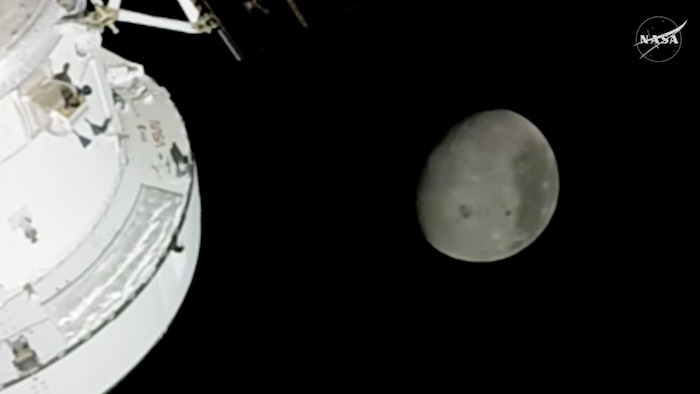
As early as Sunday, the astronauts had photographed Earth and the Moon from a unique perspective and transmitted their impressions to NASA via video after covering about two-thirds of the journey to the Moon.
Radio Silence, Solar Eclipse, and Historic Messages
A particularly dramatic moment was the roughly 40-minute radio silence while Orion disappeared behind the Moon. The crew had to work in complete isolation, without contact with Mission Control. Later, they observed a total solar eclipse from space, during which the Moon completely obscured the Sun—a once-in-a-lifetime natural spectacle for scientific analysis of the solar corona. “It still feels completely surreal,” Glover commented. “Wow, it’s incredible.” Humans probably aren’t even evolved enough to witness something like this yet. “It’s really hard to describe. It’s incredible.” Wiseman asked Mission Control for “20 new superlatives.”
During their flight, the astronauts also received a historic message from Jim Lovell, who had participated in the Apollo 8 and Apollo 13 missions and has since passed away. “It’s a historic day, and I know how busy you’ll be, but don’t forget to enjoy the view,” Lovell said in the message recorded before his death.
Pioneers of the New Artemis Generation
The four astronauts are experiencing the mission differently: For Wiseman, Glover, and Koch, it was their second flight into space; Hansen was flying for the first time. Koch is the first woman on a NASA lunar mission, Glover the first Black astronaut, and Hansen the first Canadian. Despite the intense mission, they celebrated Easter in the capsule, with an improvised dehydrated egg dish in the cramped cabin, which offers about as much space as two minivans.
Direct return to Earth after the flyby
After orbiting the Moon, Orion begins the approximately four-day return to Earth—on a free-fall trajectory, guided solely by the Moon’s gravity, without additional propulsion. For NASA, “Artemis II” is a crucial test for future missions, particularly the planned moon landing in 2028. With this, the agency is building a bridge from the Apollo era to a new generation of crewed moon flights.
This article has been automatically translated,
read the original article here.











Liebe Leserin, lieber Leser,
die Kommentarfunktion steht Ihnen ab 6 Uhr wieder wie gewohnt zur Verfügung.
Mit freundlichen Grüßen
das krone.at-Team
User-Beiträge geben nicht notwendigerweise die Meinung des Betreibers/der Redaktion bzw. von Krone Multimedia (KMM) wieder. In diesem Sinne distanziert sich die Redaktion/der Betreiber von den Inhalten in diesem Diskussionsforum. KMM behält sich insbesondere vor, gegen geltendes Recht verstoßende, den guten Sitten oder der Netiquette widersprechende bzw. dem Ansehen von KMM zuwiderlaufende Beiträge zu löschen, diesbezüglichen Schadenersatz gegenüber dem betreffenden User geltend zu machen, die Nutzer-Daten zu Zwecken der Rechtsverfolgung zu verwenden und strafrechtlich relevante Beiträge zur Anzeige zu bringen (siehe auch AGB). Hier können Sie das Community-Team via unserer Melde- und Abhilfestelle kontaktieren.