Air pollution
Where the most (fine) dust is stirred up in Lower Austria

You can't see it, but you can feel it: because particulate matter is bad for your health. Where are the hotspots in Lower Austria?
 Kronen Zeitung als bevorzugte Google-Quelle hinzufügen
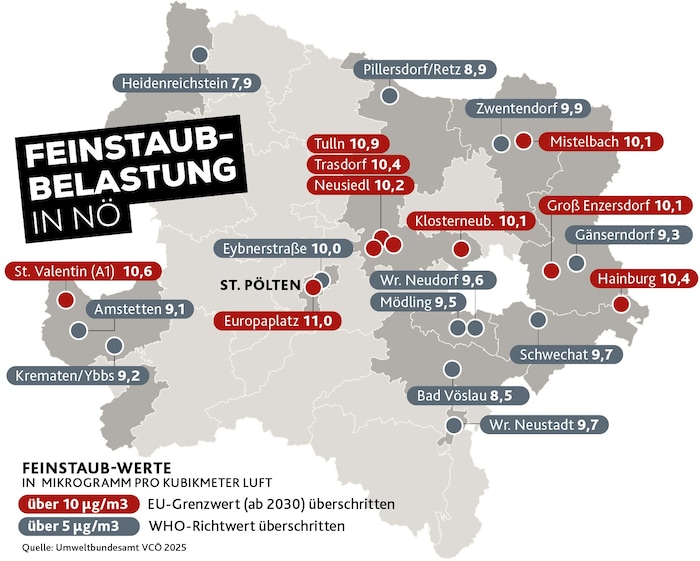
First things first: the current European limit values for particulate matter are complied with at all measuring points in Lower Austria. But there is a big "but": the EU is introducing stricter red lines for particulate matter pollution over the next five years. And those limits, which will apply from 2030, were exceeded at nine locations across the country last year. The more restrictive maximum values of the World Health Organization (WHO) were not met at 21 measuring points (see chart).
Measures needed
So there is still a lot to do in the coming years. "Because air pollutants make you ill", as environmental physician Hans-Peter Hutter emphasizes. Mobility expert Katharina Jaschinsky from the Verkehrsclub (VCÖ) knows how particulate pollution can be reduced: "Key measures include increasing the proportion of electric vehicles and speed limits."

Car exhaust fumes are a tough nut to crack. Air pollution has been considered carcinogenic for more than ten years. Air pollutants cause respiratory and cardiovascular diseases and also promote diabetes and neurodermatitis.
Umweltmediziner Hans-Peter Hutter
Peak value in St. Pölten
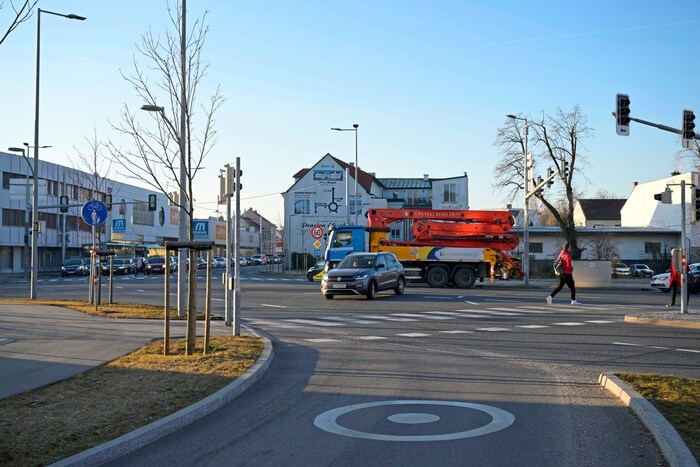
The hotspot in Lower Austria is Europaplatz in the provincial capital with an annual average of 11 micrograms of particulate matter. At eight other locations across the state - from St. Valentin to Hainburg - the measured values are just above 10 micrograms. In St. Pölten, the peak value is attributed to the fact that the measuring point is located directly on Europaplatz, the city's busiest traffic junction with 44,000 vehicles per day. "In addition, the majority of vehicles are not emission-free," says the town hall. However, there is an encouraging trend: "54 percent of all journeys in St. Pölten are already made by bus, bicycle or on foot."
Limit values of the future
The state government is convinced that Lower Austria will also be able to comply with the limit values of the future. "Dirt-spewing cars and old oil-fired heating systems have long been a thing of the past here," they say. The company distances itself from speed limits: "Air speed limits were and are not necessary on our freeways." Despite all the optimism, however, VCÖ expert Jaschinsky warns against resting on our laurels: "Because air is our most important foodstuff."
This article has been automatically translated,
read the original article here.










Da dieser Artikel älter als 18 Monate ist, ist zum jetzigen Zeitpunkt kein Kommentieren mehr möglich.
Wir laden Sie ein, bei einer aktuelleren themenrelevanten Story mitzudiskutieren: Themenübersicht.
Bei Fragen können Sie sich gern an das Community-Team per Mail an forum@krone.at wenden.