Styrian shopping basket
Food prices: Butter more expensive, flour cheaper

The Chamber of Labor has taken a tour of Styrian supermarkets. The result: the food price increases of recent years are leveling off, although individual products cost significantly more. The current prices at a glance.
 Kronen Zeitung als bevorzugte Google-Quelle hinzufügen
Once again this year, the Styrian Chamber of Labor visited various supermarkets to compare the prices of 591 products. The difference between branded, cheap and organic products was particularly striking: There was a price difference of 127 percent between identical shopping baskets.
While the cheap and organic products became cheaper overall, the prices of branded products increased. "It is definitely worth comparing prices and switching between the products in the individual shopping baskets," says AK market researcher Josef Kaufmann.
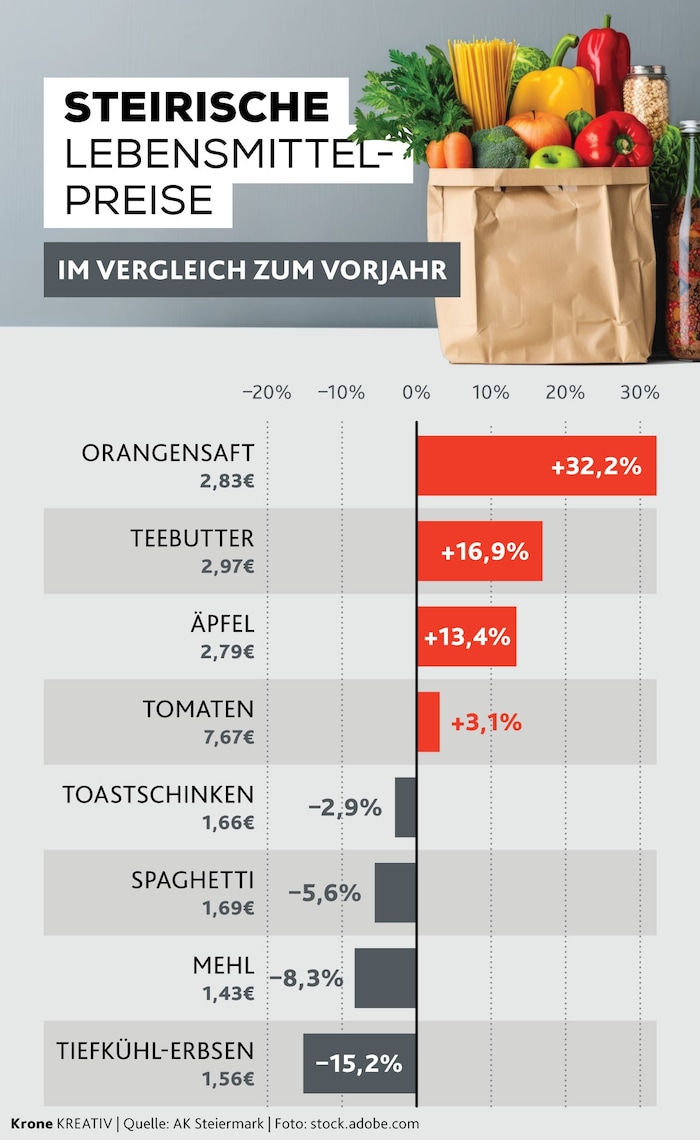
For example, the prices of individual foods have skyrocketed: A liter of orange juice costs an average of 69 cents more compared to the previous year, an increase of 32.2 percent. Butter has also become a whopping 16.9 percent more expensive, while apples are 13.4 percent more expensive. On the cheaper side, frozen peas are 15.2 percent cheaper and flour is 8.3 percent cheaper on average this year.
Family pays 1149 euros per month
The Chamber of Labor concludes: "In general, it can be said that the past few years have been characterized by sharp price increases. These have now leveled off." However, it remains to be seen whether prices will actually ease in the long term.
"That would be desirable, as affordable, healthy and sustainable nutrition should be possible for everyone without major worries," says Kaufmann. He does the math: For a family with two children, the expenditure for food and snacks is now 1149 euros per month.
The market tour also showed that around 83 percent of the products have quality labels, seals or logos. In some cases, this caused confusion because it was a mixture of official, controlled quality seals and advertising brands. It was also noticeable that the selection in the low-cost and organic segments, with 126 products each, was limited compared to the branded segment with 339 products. Nevertheless, over 95 percent of the products were labeled with indications of origin - 75 percent of which came from Austria.
This article has been automatically translated,
read the original article here.










Da dieser Artikel älter als 18 Monate ist, ist zum jetzigen Zeitpunkt kein Kommentieren mehr möglich.
Wir laden Sie ein, bei einer aktuelleren themenrelevanten Story mitzudiskutieren: Themenübersicht.
Bei Fragen können Sie sich gern an das Community-Team per Mail an forum@krone.at wenden.