Fiscal Council alarmed
Badelt: “Budget deficit 2025 continues to increase”
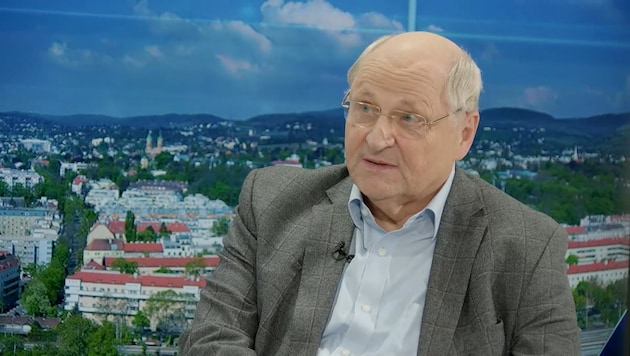

Fiscal Council President and former head of the IHS Christoph Badelt analyzes the dramatic situation of the domestic budget in an interview with krone.tv. Experts are currently assuming a budget gap of 3.5 percent.
 Kronen Zeitung als bevorzugte Google-Quelle hinzufügen
 However, economist Badelt further increases this already poor forecast value: "In our current forecast, which we are still working on but which we will publish in a few days, the value will be even higher than 3.5 percent. And due to the poor economic forecasts for the coming year, the budget deficit will continue to increase in 2025."
By then, it is likely to be heading towards four percent. This is far more than the EU Maastricht criteria allow. The future federal government must therefore now take the path of strict budget consolidation: "The EU has set Austria a clear path: Two and a half billion euros a year is the minimum that must now be saved each year in addition. But the savings are not just about what Brussels tells us to do. We have major reform issues of our own to deal with. For example, the pension issue and health and care."
Raising the retirement age
"A double budget for 2025/26 should be drawn up, showing all the necessary reform measures for pensions, health and care. However, care must be taken to ensure that savings do not put even more pressure on growth." When it comes to pensions, for example, an increase in the retirement age must be considered.
Badelt: "This cannot be done immediately, but in the medium term. Because we are getting older and older." An increase in the retirement age would therefore be sensible and necessary for the economist. For example, in several stages to 67, even if the increase would only be reached and completed in many years. Although the pension problem will continue to increase over the next few years due to the demographic situation, the increase will then be lower from 2030 and 2031.
Problem Germany
A major problem for the weak domestic economic growth is the economic situation in Germany, which is also very subdued: "This is partly responsible for the fact that Austrian industry is also currently very weak. Because we are dependent on the German situation." Ultimately, it is important to overcome the pessimistic mood when it comes to consumption: "We are currently experiencing a kind of cautious saving. Above all, healthy optimism is essential for the economy."
In any case, much more money should be spent on investing in the future in Austria. And also for the education sector: "We need more investment in education. That is an investment in the future. But I am skeptical about new taxes."
Watch the full interview in the video above.
This article has been automatically translated,
read the original article here.











Da dieser Artikel älter als 18 Monate ist, ist zum jetzigen Zeitpunkt kein Kommentieren mehr möglich.
Wir laden Sie ein, bei einer aktuelleren themenrelevanten Story mitzudiskutieren: Themenübersicht.
Bei Fragen können Sie sich gern an das Community-Team per Mail an forum@krone.at wenden.