The voice of Austria
Why non-wage labor costs must fall now


There is a gap between gross and net. This is because employees in Austria shoulder a huge burden. In an international comparison, Austria is not only in the inglorious top ranks for taxes, but also for non-wage labor costs. Both employees and crisis-hit companies will benefit from a reduction in taxes. That is why the motto now must be: relieve the burden on Austrians - and boost the economy!
 Kronen Zeitung als bevorzugte Google-Quelle hinzufügen
 The burden on labor is far too high: In terms of non-wage labor costs, Austria is in the inglorious 5th place in the EU. Companies pay a whopping 29.6 percent on top of gross wages. The result is the "real" labor costs. However, there is a huge gap between this and the net wage.
39,000 euros net annual salary, 72,500 euros in costs
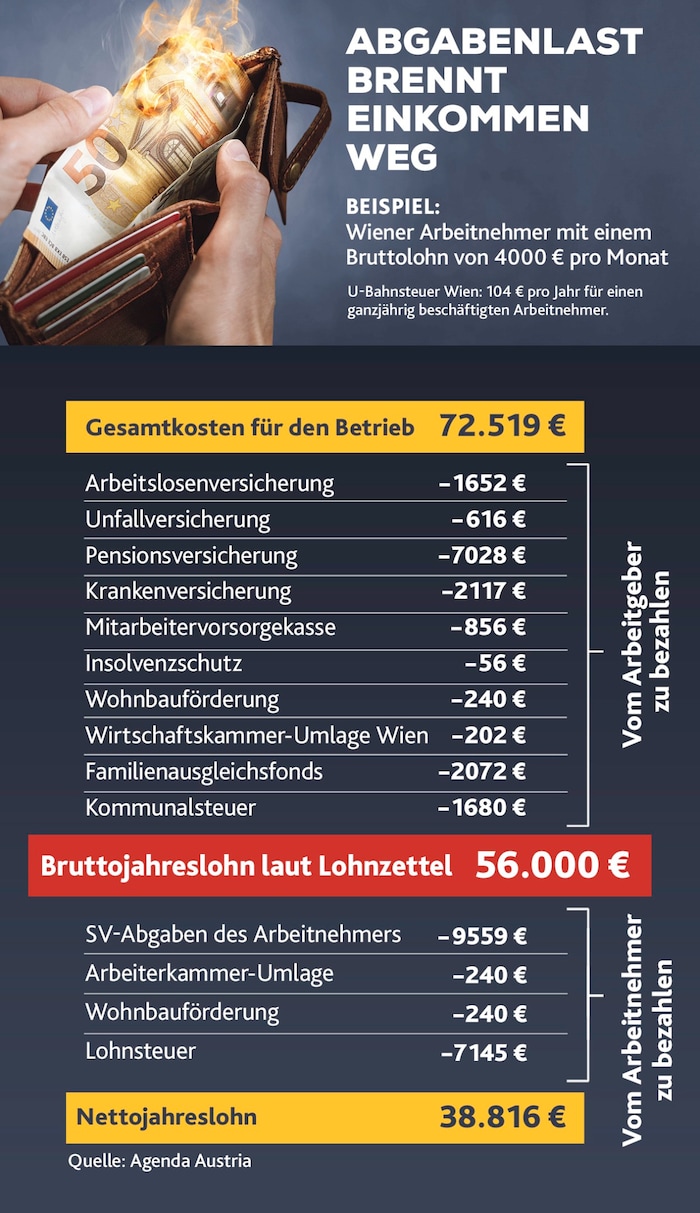
Example: A (Viennese) employee with a gross monthly salary of 4,000 euros costs his company 72,500 euros per year (see table below). From this, 16,500 euros in non-wage labor costs are deducted, which are borne by the employer. This results in 56,000 euros, which is shown on the payslip. This is then subject to social security contributions and the AK levy as well as wage tax of 7100 euros. "In the end, this leaves a net amount of 38,800 euros," emphasizes Denes Kucsera from the Agenda Austria think tank.
The biggest chunk of employer contributions is pension insurance, which accounts for 12.55 percent and therefore over 7,000 euros. Health insurance (3.78 percent) and unemployment insurance (2.95 percent) are also significant.

Thanks to the huge reserves, the Chamber of Labor and the Chamber of Commerce can manage without income for two years.

Dénes Kucsera, Agenda Austria
Bild: Elke Mayr
However, this is offset by specific benefits; a reduction would probably have consequences due to the insurance principle and could cause financing problems in the welfare state.
However, a not-so-small part of the non-wage labor costs could be saved more easily or financed from the budget. An employer pays around EUR 2,000 (3.7 percent) for an average employee into the Family Burdens Equalization Fund (which finances child benefit, family allowances, etc., "FLAF" for short), EUR 1,680 goes to municipal tax, EUR 202 to the Chamber of Commerce levy 2 and EUR 240 to housing subsidies. In Vienna, the contribution to the housing subsidy, which is paid by employees as well as employers, will increase by as much as 50 percent next year.
Seven billion euros for family benefits
In the long term, the government must tackle real reforms in order to get a grip on spending on healthcare and pensions, for example. Then taxes can also be reduced. But there are also short-term possibilities. For example, wage costs for companies can remain the same and employees can still receive more net income thanks to lower non-wage labor costs.
The government program already includes the abolition of the contribution to the FLAF, which is to be financed from the state budget in future. However, this is subject to a budget proviso and would therefore require counter-financing. According to economist Monika Köppl-Turyna, between 30 and 40 percent of this amount is self-financing due to the positive effects on the economy.
A reduction is partly self-financing, as income also increases thanks to more employment.

Monika Köppl-Turyna, Eco Austria
Bild: Weinwurm GmbH
Kucsera has another approach for short-term help: the Chamber of Commerce has two billion euros in reserves "on the high edge", while the Chamber of Labor is sitting on a whopping 600 million euros.
Returning the chambers' enormous reserves
If the chambers suddenly had no more income at all, they could manage for two years with the existing reserves. Kucsera: "After two years of pausing the reserves, we would be faced with the decision to raise contributions or permanently abolish the compulsory contributions."
A reduction would not only benefit the companies. "Falling wage costs are certainly passed on to employees, and in the short term, a quarter to half of them are," says Köppl-Turyna. Everyone benefits because companies have more leeway to raise wages again.
This article has been automatically translated,
read the original article here.











Willkommen in unserer Community! Eingehende Beiträge werden geprüft und anschließend veröffentlicht. Bitte achten Sie auf Einhaltung unserer Netiquette und AGB. Für ausführliche Diskussionen steht Ihnen ebenso das krone.at-Forum zur Verfügung. Hier können Sie das Community-Team via unserer Melde- und Abhilfestelle kontaktieren.
User-Beiträge geben nicht notwendigerweise die Meinung des Betreibers/der Redaktion bzw. von Krone Multimedia (KMM) wieder. In diesem Sinne distanziert sich die Redaktion/der Betreiber von den Inhalten in diesem Diskussionsforum. KMM behält sich insbesondere vor, gegen geltendes Recht verstoßende, den guten Sitten oder der Netiquette widersprechende bzw. dem Ansehen von KMM zuwiderlaufende Beiträge zu löschen, diesbezüglichen Schadenersatz gegenüber dem betreffenden User geltend zu machen, die Nutzer-Daten zu Zwecken der Rechtsverfolgung zu verwenden und strafrechtlich relevante Beiträge zur Anzeige zu bringen (siehe auch AGB). Hier können Sie das Community-Team via unserer Melde- und Abhilfestelle kontaktieren.