Sensational find
Burgenland woman from the Stone Age poses a mystery
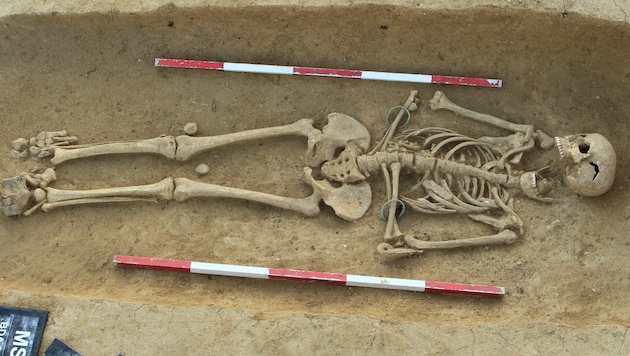

Archaeologists have discovered sensational finds in Mattersburg. The area was already inhabited in the 5th millennium BC. Wine was also a major topic back then.
 Kronen Zeitung als bevorzugte Google-Quelle hinzufügen
 In Mattersburg, the time of the corona pandemic was used to leave no stone unturned. Scientists unearthed some great finds, meaning that the history of Burgenland had to be partially rewritten. Some of the extensive finds will be presented in the original by archaeologist Dorothea Talaa at the event "Treasures from the soil of Mattersburg" on March 13 from 6.30 pm in the Bauermühle.
Oldest grave in Mattersburg
The excavators discovered spectacular finds, particularly in the area of the soccer academy, such as the oldest grave in Mattersburg to date, in which a woman was buried in the middle of the 5th millennium BC. This was probably an immigrant woman, as the regular burial method of the local population at this time was cremation. Furthermore, the only cremation burial site of the Makó culture in Austria to date was discovered, dating back to the 3rd millennium BC.
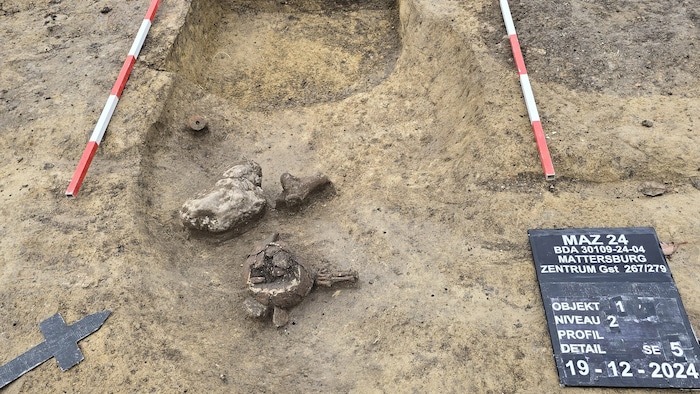
These people are likely to have cultivated various traditions of the eastern Carpathian Basin or Black Sea region, as, for example, an originally erected limestone block of considerable size has identified the cemetery area of Mattersburg as a sacred area.
Settlement was fortified
In the early Bronze Age, in the 2nd millennium BC, times seem to have been uncertain, as the settlement of Mattersburg was fortified, as evidenced by an extensive fortification ditch found during the excavations next to the Burgenland Football Academy.
During the excavations, the economic area of a Late Bronze Age settlement from the end of the 2nd and beginning of the 1st millennium BC was located at the western end of the present-day area of Mattersburg. Ceramic vessels were found that indicate the consumption of wine.
Wine as a symbol of resurrection
At the soccer academy, the archaeologists also discovered a cremation burial ground from the early Iron Age (1st millennium BC) with 22 family graves of the local upper class. These were originally covered with burial mounds and contained rich grave goods, such as large conical-necked vessels filled with wine, covered with a lid and sealed with earth pitch. Wine was apparently associated with wealth at the time, was regarded as a symbol of resurrection and was also of sacred significance in the afterlife.
This article has been automatically translated,
read the original article here.











Da dieser Artikel älter als 18 Monate ist, ist zum jetzigen Zeitpunkt kein Kommentieren mehr möglich.
Wir laden Sie ein, bei einer aktuelleren themenrelevanten Story mitzudiskutieren: Themenübersicht.
Bei Fragen können Sie sich gern an das Community-Team per Mail an forum@krone.at wenden.