Feeding instead of charging
Mushroom-powered battery degrades itself
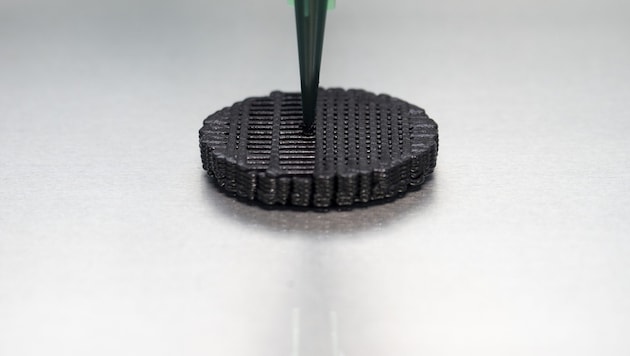

A battery that you don't have to charge, but feed? This is exactly what Swiss researchers have achieved with their 3D-printed mushroom battery. The living battery could power sensors for agriculture or research in remote regions. Once its work is done, it dissolves itself from the inside.
 Kronen Zeitung als bevorzugte Google-Quelle hinzufügen
 Strictly speaking, the mushroom battery is a microbial fuel cell, as the Swiss Federal Laboratories for Materials Science and Technology (Empa) announced on Thursday. It uses the metabolism of two different types of fungi to generate electricity. At the anode, the negative pole of the cell, a yeast fungus is fed with sugar. As it processes these nutrients, it releases electrons. On the other side of the cell, a white rot fungus produces an enzyme that captures the electrons and conducts them out of the cell.
Biodegradable
The battery is produced using a 3D printer. The fungal cells are mixed into the printing ink. If the battery is dry, it does not produce any electricity. It is activated by adding water and nutrients. The biggest advantage of the mushroom battery is that, unlike conventional batteries, it is not only completely non-toxic, but also biodegradable.
The researchers led by Carolina Reyes presented the battery in a study in the journal "ACS Sustainable Chemistry & Engineering". The researchers now want to make the mushroom battery more efficient and longer-lasting, as they explained in the press release. They also want to look for other types of mushrooms that are suitable for supplying electricity.
This article has been automatically translated,
read the original article here.











Da dieser Artikel älter als 18 Monate ist, ist zum jetzigen Zeitpunkt kein Kommentieren mehr möglich.
Wir laden Sie ein, bei einer aktuelleren themenrelevanten Story mitzudiskutieren: Themenübersicht.
Bei Fragen können Sie sich gern an das Community-Team per Mail an forum@krone.at wenden.