Final moment
Probe films comet being vaporized near the sun
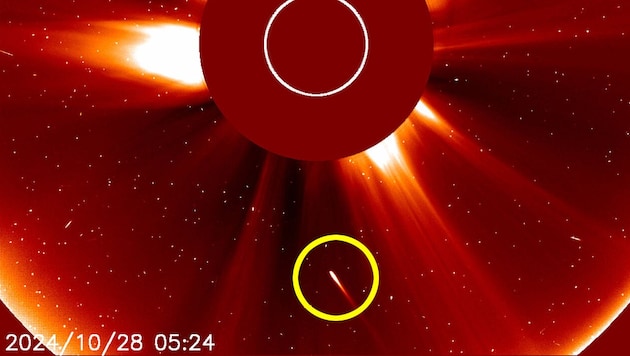

According to original calculations, comet C/2024 S1, which was discovered on September 27, was supposed to be visible to the naked eye in the night sky on Halloween. However, this came to nothing as the icy snowball came too close to the sun and burned up.
 Kronen Zeitung als bevorzugte Google-Quelle hinzufügen
 On Monday, the comet reached perihelion (its closest point to the sun), where temperatures rose to around 1000 degrees Celsius. At this point, the icy components in the core of C/2024 S1 had completely evaporated and the small celestial body disintegrated.
With the help of the Solar and Heliospheric Observatory (SOHO), a probe built by a consortium for the European Space Agency (ESA) and its US counterpart, NASA, astronomers were able to observe the fascinating spectacle in space in detail.
The animation (see above), composed of individual images from the observatory, shows the last moments of C/2024 S1 (see above) on October 28.
Comet from the group of "solar streaks"
The comet was discovered with the help of the Terrestrial-impact Last Alert System (ATLAS) in Hawaii. It belonged to a group of comets known as Kreutz-Sungrazers (solar streaks), which come very close to the sun during their perihelion.
Probe has been working in space for 29 years
The SOHO space observatory was launched into space on an "Atlas" rocket in November 1995 and reached its final position two months later - around 1.5 million kilometers from Earth.
This article has been automatically translated,
read the original article here.











Da dieser Artikel älter als 18 Monate ist, ist zum jetzigen Zeitpunkt kein Kommentieren mehr möglich.
Wir laden Sie ein, bei einer aktuelleren themenrelevanten Story mitzudiskutieren: Themenübersicht.
Bei Fragen können Sie sich gern an das Community-Team per Mail an forum@krone.at wenden.