Search operation in the dark
Avalanche tragedy on the glacier: Two snowboarders dead
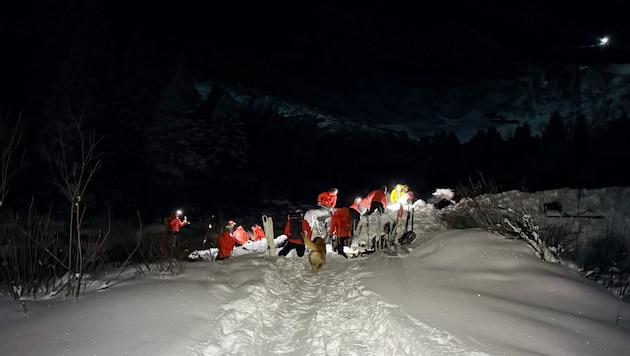

Terrible accident in Tyrol: On Sunday, two snowboarders were buried by an avalanche on the Stubai Glacier. A search was launched after they failed to return home and were reported missing. Late in the evening, the bodies of the two locals were finally discovered.
 Kronen Zeitung als bevorzugte Google-Quelle hinzufügen
 Shortly before 6 p.m., the two 37-year-old locals had been reported missing to the police because they had not returned from a snowboarding trip on the Stubai Glacier as agreed. During the initial investigations, the car of one of the two men was finally discovered in the parking lot of the ski resort at 6:55 p.m.
Large search operation launched in the evening
As the two men could not be found at the valley station or in any of the surrounding restaurants or refreshment stops, a large-scale search operation was launched at around 7:30 p.m., involving the Neustift mountain rescue service, dog handlers from the Tyrol mountain rescue service, the Neustift volunteer fire department, the police helicopter, and the alpine police. Drones were also used.

Two tracks were found in the area where the avalanche had started.
Die Alpinpolizei
Avalanche discovered by drone
"A parallel cell phone tracking operation identified a search area between the Dresdner Hut and the Gamsgarten valley station. With the help of drone images, it was determined during the search operation that an avalanche had occurred in the open ski area in the Mutterbergl area at an altitude of 2,115 meters," according to the police. Two tracks were also found in the area where the avalanche started.
Avalanche transceiver signals received at the avalanche cone
The avalanche was approximately 300 meters long. Shortly before 10 p.m., the worst fears were confirmed. The rescue team detected two avalanche transceiver signals at the avalanche cone. Immediately afterwards, the two buried snowboarders were rescued by the mountain rescue service. However, the emergency doctor could only confirm the death of the two men.
Situation on the mountain remains extremely dangerous
Snowfall over the weekend and during the night on Monday has led to an increase in avalanche risk in western Austria, particularly in Tyrol and Vorarlberg. Starting Monday, parts of Tyrol and Vorarlberg above the tree line will be under avalanche warning level four on a five-point scale. According to the avalanche warning service, the Allgäu and Lechtal Alps, the Verwall Group, and the Silvretta are among the areas affected.
As the province of Tyrol announced on Monday morning, the avalanche danger will also rise to level 4 in the Lechtal Alps East, Mieminger Mountains, and Karwendel West regions during the course of the day due to the continuing heavy precipitation. Once again, people are being urged to exercise "the utmost caution, plan their tours carefully, and stay on secured slopes."
A warning has been issued against winter sports away from secured slopes. The situation is not expected to improve significantly in the coming days. Further, in some cases heavy, snowfall is expected in some areas until Tuesday. Therefore, a high avalanche risk is still to be expected.
This article has been automatically translated,
read the original article here.










Willkommen in unserer Community! Eingehende Beiträge werden geprüft und anschließend veröffentlicht. Bitte achten Sie auf Einhaltung unserer Netiquette und AGB. Für ausführliche Diskussionen steht Ihnen ebenso das krone.at-Forum zur Verfügung. Hier können Sie das Community-Team via unserer Melde- und Abhilfestelle kontaktieren.
User-Beiträge geben nicht notwendigerweise die Meinung des Betreibers/der Redaktion bzw. von Krone Multimedia (KMM) wieder. In diesem Sinne distanziert sich die Redaktion/der Betreiber von den Inhalten in diesem Diskussionsforum. KMM behält sich insbesondere vor, gegen geltendes Recht verstoßende, den guten Sitten oder der Netiquette widersprechende bzw. dem Ansehen von KMM zuwiderlaufende Beiträge zu löschen, diesbezüglichen Schadenersatz gegenüber dem betreffenden User geltend zu machen, die Nutzer-Daten zu Zwecken der Rechtsverfolgung zu verwenden und strafrechtlich relevante Beiträge zur Anzeige zu bringen (siehe auch AGB). Hier können Sie das Community-Team via unserer Melde- und Abhilfestelle kontaktieren.