Green Greenland
Earth’s second largest ice sheet is melting at an extreme rate
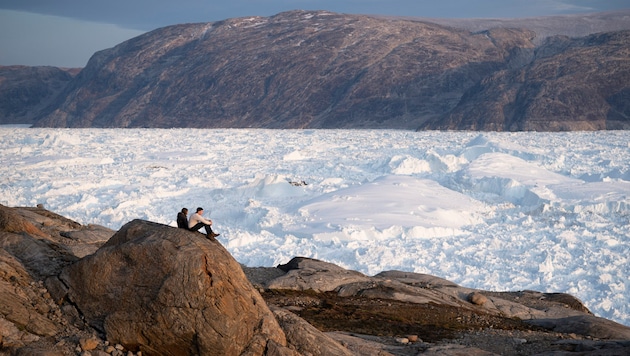

The Greenland ice sheet shrank by an average of 196 cubic kilometers per year between September 2010 and August 2022. The annual amount of melting fluctuated between four and 464 cubic kilometers.
 Kronen Zeitung als bevorzugte Google-Quelle hinzufügen
 For the study, the scientists compared altitude measurements from the European Space Agency's (ESA) CryoSat-2 and the US space agency NASA's ICESat-2 satellite missions for the first time.
CryoSat-2 uses radar to measure the height of the ice on the Greenland ice sheet, while ICE-Sat-2 uses lasers. Radar has the advantage that it penetrates through clouds, meaning that it can also be used when the sky is cloudy.
However, the radar frequencies used penetrate up to ten meters into snow surfaces, so the measurement is relatively inaccurate and must be improved by correction calculations. The laser, on the other hand, measures the snow and ice surface quite precisely - but only when the sky is almost cloudless. Since the launch of the ICESat-2 mission in 2018, both systems have been measuring in parallel.
Overall, the differences only account for around six percent of the observed trend.
Reduction in ice height by 11.6 centimetres
Researchers used the measurement data from the two satellite systems to determine an average reduction in ice height of 11.6 centimetres per year across the entire ice sheet from 2018 to 2022. However, this melting was very unevenly distributed: In the large inner area it was only 6.3 centimetres, in the marginal areas 54.3 centimetres, i.e. around nine times as much.
Further findings:
- For the period 2010 to 2022, scientists calculated an average annual ice loss of 79 cubic kilometers in the inner area and 117 cubic kilometers in the marginal areas.
- This total of 196 cubic kilometers per year results in a volume loss of 2,352 cubic kilometers for the entire study period. This is almost equivalent to the volume of water in Africa's largest lake, Lake Victoria, with a volume of 2,760 cubic kilometers.
- According to a study from 2023, the melting Greenland ice has led to a rise in global sea levels of 13.6 millimetres since 1992.
This article has been automatically translated,
read the original article here.











Da dieser Artikel älter als 18 Monate ist, ist zum jetzigen Zeitpunkt kein Kommentieren mehr möglich.
Wir laden Sie ein, bei einer aktuelleren themenrelevanten Story mitzudiskutieren: Themenübersicht.
Bei Fragen können Sie sich gern an das Community-Team per Mail an forum@krone.at wenden.