Success in Greece
Temple of Poseidon excavated by Austrians
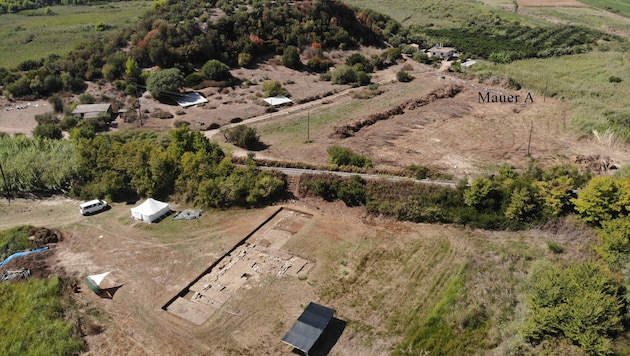

Researchers from Austria were involved in the excavation of the famous temple of the sea god Poseidon on the west coast of the Peloponnese in Greece. The monumental ancient sanctuary is 28 meters long and over nine meters wide. The temple had been searched for for more than a century.
 Kronen Zeitung als bevorzugte Google-Quelle hinzufügen
 Archaeologists have discovered the sanctuary of Poseidon of Samikon on the west coast of the Peloponnese and uncovered a large temple. Austrian and Greek researchers, together with geophysicists and geoarchaeologists, were able to uncover the foundation walls back in 2021. The excavations confirm the information provided by the ancient historian Strabo, who described the sanctuary as the religious center of the Triphylian cities.
Entire length of building uncovered
Researchers with the participation of the Austrian Academy of Sciences (ÖAW) have now been able to uncover the entire length of the building and also make new discoveries.
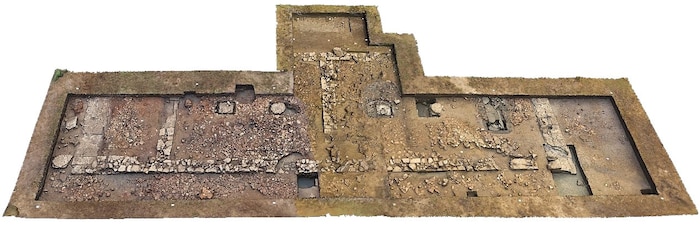
The 28-metre-long temple, which probably dates back to the 6th century BC, is divided into two rooms structured by interior pillars and a columned porch. The roof was dismantled around 300 BC and stored inside the building. This is explained by Birgitta Eder, researcher at the Austrian Archaeological Institute of the Austrian Academy of Sciences, who also heads the branch office in Athens.
Marble basin and bronze plaque discovered
During the excavations funded by the Gerda Henkel Foundation and the Austrian Academy of Sciences, the archaeologists also discovered fragments of a large archaic marble basin with a diameter of around one meter, a ritual purification vessel known as a "perirrhanterion". It was repaired with iron staples in ancient times. Together with a part found in 2022, it can now be almost completely reconstructed.
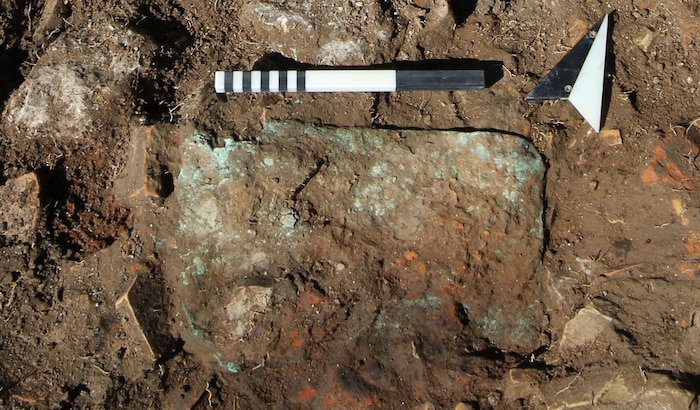
A large bronze plaque was also found, which was originally attached to one of the temple's mud-brick walls. The plaque is in a very fragile condition and therefore had to be salvaged in a block with the surrounding soil.
Wall as protection from lagoons
Strabon described the sanctuary of Poseidon as a "grove of wild olive trees". This is why the scientists also searched around the temple to find out more about the extent of the complex. In fact, after removing the dense vegetation to the north of the temple, they were able to document the course of a mighty double-shell wall. This possibly marked the sacred precinct of Poseidon and probably served as protection from the nearby lagoons.
The site at Kleidi-Samikon, located near a group of hills, lies in a landscape dominated by lagoons and coastal marshes. Due to its exposed and safe location near the sea, a settlement was established there as early as the Mycenaean period, which lasted for several centuries and from which the route through the marshes could be controlled.
This article has been automatically translated,
read the original article here.










Da dieser Artikel älter als 18 Monate ist, ist zum jetzigen Zeitpunkt kein Kommentieren mehr möglich.
Wir laden Sie ein, bei einer aktuelleren themenrelevanten Story mitzudiskutieren: Themenübersicht.
Bei Fragen können Sie sich gern an das Community-Team per Mail an forum@krone.at wenden.