Report of the province of Upper Austria
“Residual risk” remains after last year’s floods
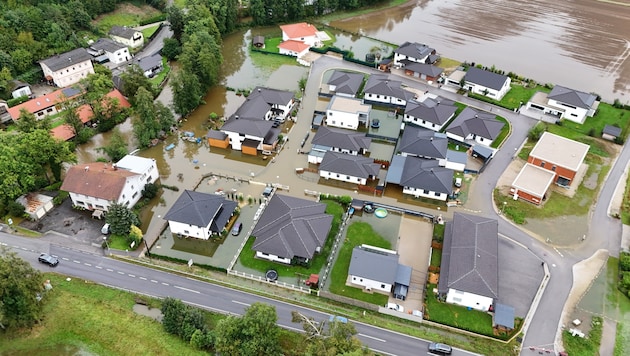

The extreme rainfall in September 2024 had fatal consequences in parts of the province - these have now been dealt with by the province of Upper Austria. The report also notes a discharge for the drinking water supply.
 Kronen Zeitung als bevorzugte Google-Quelle hinzufügen
 Up to 150 centimetres of snowfall in just four days - the ski resorts in Upper Austria can only dream of that this winter. They fell on our mountains in mid-September last year and contributed to the fact that the extreme precipitation did not lead to extreme flooding. Nevertheless, some villages were still under water. The events have now been reviewed by the Upper Austrian Water Management Department. And there were also lessons to be learned from the damage.
Drinking water supply needs a "second pillar"
For example, that the drinking water supply should be put on a "second pillar". This is because in the Mühlviertel region in particular, the drinking water had been washed in and contaminated at 41 supply facilities - even at facilities where "no impairment of drinking water quality has ever been detected".
In addition, the disinfection measures are to be improved or secured, as some UV irradiators had reached their performance limits and had also switched off in some cases. An early warning system for water suppliers and better advance warnings from the authorities for water cooperatives should prevent them from being "surprised by extreme events". On a small scale, precipitation reached more than 1000-year values last September - for example at measuring points in Sandl or Ibm. The impact on watercourses was also massive, exceeding the 100-year event mark.
Mauerkirchen was hit the hardest
"The protective structures that had already been built proved their worth and prevented major damage," the report states. However, the report identifies a need for further retention basins in the Kremstal to protect it from catastrophic flooding. And in the Mühlviertel, retention basins for the Feldaist above Freistadt "absolutely" need to be built in order to protect the district town and downstream residents.
As is well known, Mauerkirchen, where a new settlement was "flooded", was the worst hit. Here, the Sonnleiten retention basin in Helpfau-Uttendorf, which can hold 440,000 cubic meters of water, was affected by an "enormous overload". Although the protective measure basically worked, there is always a "residual risk" if there is too much water, according to the report - in Mauerkirchen it hit hard.
This article has been automatically translated,
read the original article here.











Da dieser Artikel älter als 18 Monate ist, ist zum jetzigen Zeitpunkt kein Kommentieren mehr möglich.
Wir laden Sie ein, bei einer aktuelleren themenrelevanten Story mitzudiskutieren: Themenübersicht.
Bei Fragen können Sie sich gern an das Community-Team per Mail an forum@krone.at wenden.