Discovery in limestone quarry
Completely new species of pterosaur discovered in Bavaria
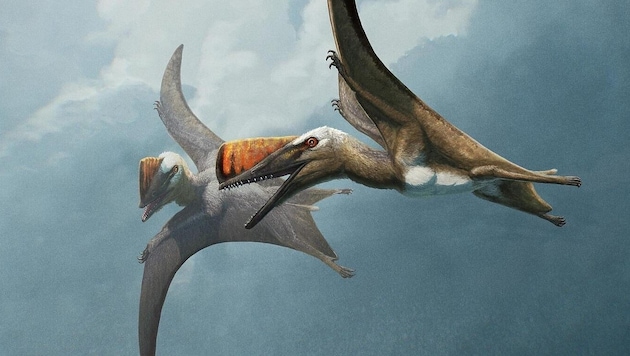

Large head, long neck, short tail: researchers have discovered a new species of pterosaur in Bavaria. The remains of the animal are unusually well preserved and would provide important insights into the evolution of pterosaurs, they say.
 Kronen Zeitung als bevorzugte Google-Quelle hinzufügen
 The new species was given the scientific name Skiphosoura bavarica - meaning "swordtail from Bavaria" - because of its short, pointed tail, as the team led by paleontologist David Hone from Queen Mary University of London explains in the journal "Current Biology".
Newly discovered dinosaur species closes gap
What's special: The specimen of Skiphosoura bavarica is unusually large for the Jurassic period and has been preserved in three dimensions. First author David Hone speaks of an "incredible find", which he has been studying and describing since 2022. "It helps us to find out how these amazing flying animals lived and evolved." For a long time, there had been a big gap.
According to the Natural History Museum in Berlin, pterosaurs lived from 200 to 65 million years ago. In the Jurassic period, the flying reptiles were rather small; in the Cretaceous period, they reached enormous sizes with a wingspan of ten meters in some cases. According to the study, the new species was discovered in 2015 in a limestone quarry near Solnhofen in Bavaria - other important pterosaurs had previously been found in the region.
According to the authors of the study, palaeontology had long divided pterosaurs into two main groups: The early species had short heads and necks, a long fifth toe and a long tail. In the later, much larger specimens, it was the other way around: they had large heads, long necks, a short fifth toe and short tails. However, it was not clear for a long time how these body characteristics changed over time.
According to co-author and taxidermist Stefan Selzer, Skiphosoura exhibited characteristics of both main groups. According to the study, the species and other previously discovered intermediate species thus show how pterosaurs gradually changed.
Provides important insights into evolution
"Skiphosoura represents an important new form for investigating the evolutionary relationships between the pterosaurs (pterosaurs, note) and thus also how this lineage evolved and changed," explained co-author Adam Fitch from the University of Wisconsin-Madison.
This article has been automatically translated,
read the original article here.











Da dieser Artikel älter als 18 Monate ist, ist zum jetzigen Zeitpunkt kein Kommentieren mehr möglich.
Wir laden Sie ein, bei einer aktuelleren themenrelevanten Story mitzudiskutieren: Themenübersicht.
Bei Fragen können Sie sich gern an das Community-Team per Mail an forum@krone.at wenden.