The Hormuz Crisis Escalates
Trump: “Open the damn strait, you bastards!”
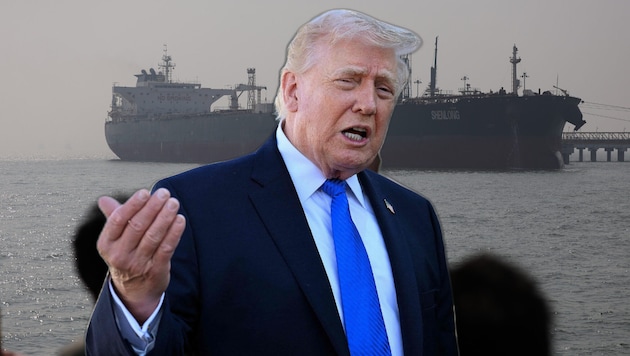

There’s no sign of an Easter truce: U.S. President Donald Trump is hurling harsh threats at Iran, which is firing back—and oil prices continue to rise in the meantime. This price spiral could intensify in the near future if the U.S. and Iran fail to reach an agreement on the Strait of Hormuz.
 Kronen Zeitung als bevorzugte Google-Quelle hinzufügen
 Donald Trump is focused on the Strait of Hormuz, which Iran has effectively blocked since the start of the conflict—and the US president, to put it mildly, does not approve. “Open the damn Strait (of Hormuz), you crazy bastards, or you’ll end up in hell,” he wrote on Easter Sunday on his platform Truth Social.
Iran apparently no longer intends to tolerate the insults and has responded with threats of its own. Should the U.S. and Israel intensify their attacks, even more shipping lanes could be endangered, warned Ali-Akbar Velayati, foreign policy advisor to Iran’s Supreme Leader, according to the pro-government Iranian broadcaster Press TV on Monday.
The Hormuz Ultimatum
- The Strait of Hormuz is a shipping lane that is of enormous importance to global trade. Iran has effectively blocked it since the start of the war.
- On March 21, Trump issued an ultimatum to Iran to open the Strait of Hormuz. If Iran failed to do so, the U.S. would attack and destroy Iran’s power plants.
- Since then, Trump has extended this ultimatum several times. Most recently, he set the deadline for Tuesday at 8:00 p.m. U.S. Eastern Time (2:00 a.m. CEST on Wednesday).
- Iran rejects the ultimatum.
Fatal consequences for prices
This could affect the Bab al-Mandab Strait near Yemen and thus the entrance to the Red Sea and the Suez Canal further north. That would be disastrous: About 12 percent of all global trade passes through the canal.
The closure of the Strait of Hormuz alone has massive repercussions on the global economy—should even more shipping lanes be affected, experts fear that prices worldwide could skyrocket even further.
“Last-ditch effort” for an agreement
The U.S., Iran, and regional mediators are making one“last-ditch effort”to negotiate the terms of a potential 45-day ceasefire, according to the U.S. news portal “Axios,” citing insiders. However, the insiders consider the chances of an agreement to be slim—yet, according to them, it is the only way to still prevent a dramatic escalation.
Iran has drawn up its “demands and claims” and communicated them to the mediators, said Foreign Ministry spokesman Ismail Baghai, according to the state news agency IRNA. Baghai described the U.S. demands as “excessive and unacceptable.” Negotiations, he said, are incompatible with ultimatums and threats. The spokesperson was referring to a 15-point plan from the U.S. to end the war.
Iran will only reopen the Strait of Hormuz once “the damages caused by the imposed war are fully compensated through a portion of the transit fees,” wrote Iranian Parliament Speaker Mohammed-Bagher Ghalibaf. Iran plans to implement a toll system for passage through the strait.
Impact Feltin the "Börserl"
Meanwhile, consumersarealreadyfeelingtheimpactof the war every day at the gas station. On Easter Sunday, a liter of diesel cost an average of 2.15 euros at Austrian gas stations, and a liter of premium gasoline cost 1.75 euros—which is still expensive, but slightly cheaper overall than on Saturday.
On Easter Monday, however, crude oil prices are moving in the opposite direction. The price of Brent crude oil rose by up to 2.6 percent in the morning to $112 per barrel (159 liters). Since the start of the war in Iran, the price of Brent crude—the global benchmark—has risen by just over half.
This article has been automatically translated,
read the original article here.











Willkommen in unserer Community! Eingehende Beiträge werden geprüft und anschließend veröffentlicht. Bitte achten Sie auf Einhaltung unserer Netiquette und AGB. Für ausführliche Diskussionen steht Ihnen ebenso das krone.at-Forum zur Verfügung. Hier können Sie das Community-Team via unserer Melde- und Abhilfestelle kontaktieren.
Hinweis in eigener Sache: Schon bald erwartet Sie auf krone.at ein rundum erneuerter Forenbereich mit vielen neuen Features! Mehr Informationen finden Sie hier.
User-Beiträge geben nicht notwendigerweise die Meinung des Betreibers/der Redaktion bzw. von Krone Multimedia (KMM) wieder. In diesem Sinne distanziert sich die Redaktion/der Betreiber von den Inhalten in diesem Diskussionsforum. KMM behält sich insbesondere vor, gegen geltendes Recht verstoßende, den guten Sitten oder der Netiquette widersprechende bzw. dem Ansehen von KMM zuwiderlaufende Beiträge zu löschen, diesbezüglichen Schadenersatz gegenüber dem betreffenden User geltend zu machen, die Nutzer-Daten zu Zwecken der Rechtsverfolgung zu verwenden und strafrechtlich relevante Beiträge zur Anzeige zu bringen (siehe auch AGB). Hier können Sie das Community-Team via unserer Melde- und Abhilfestelle kontaktieren.